Red Light Therapy for Tendonitis: What Athletes Should Know
Red Light Therapy for Tendonitis: What Athletes Should Know
Few things stall a training plan like a sore tendon. Whether it's your Achilles after a running block, your elbow after weeks of padel, or your shoulder after a heavy swim season, tendon problems tend to build slowly and linger. Red light therapy often comes up as a recovery option. In this article we explain what the research says, how near-infrared light reaches tendons, how to fit the Recovery Patch into your routine, and when it's time to see a professional.
Can Red Light Therapy Help Tendonitis?
Red light therapy for tendons has been studied for over two decades, mostly using low-level lasers in clinics. The results are promising but not consistent, and the dose turns out to be crucial.
- A 2010 systematic review by Tumilty and colleagues concluded that low-level laser therapy may be effective for tendinopathy, provided recommended doses are used. In pooled Achilles data, it reduced pain by 13.6 mm on a 100 mm scale. An independent critique of the same review noted that the overall evidence remained inconclusive, partly due to weak study designs.
- A 2022 meta-analysis in BMJ Open on lower-limb tendinopathy and plantar fasciitis found that laser therapy significantly reduced pain and disability in the short and medium term, and that recommended doses reduced pain more when added to exercise therapy than exercise therapy alone.
- A 2015 review of shoulder tendinopathy found clinically relevant pain relief, both alone and combined with physiotherapy. Notably, trials that used inadequate doses showed no effect.
The takeaway: light therapy looks most useful as an add-on to a proper rehab program.
Red Light Therapy for Achilles Tendonitis
The Achilles tendon is one of the most studied areas, and the findings show why it's important to stay realistic.
- Positive: In a 2008 randomised trial in the American Journal of Sports Medicine, 52 recreational athletes with chronic Achilles tendinopathy did eccentric exercises for 8 weeks, combined with either real or placebo laser therapy at 820 nm. The researchers concluded that the laser group recovered faster.
- Neutral: A 2012 randomised trial using 810 nm laser alongside eccentric exercises found no added benefit compared with exercise alone.
- Neutral: A 2024 trial with 60 patients with midportion Achilles tendinopathy also found no significant extra benefit from adding laser therapy to eccentric exercises. The authors advised making evidence-based exercise the primary treatment.
What all these studies have in common: eccentric loading exercises remain the foundation of Achilles rehab. Light therapy may help some athletes on top of that.
How Near-Infrared Light Reaches Tendons
Red and near-infrared light work differently in the body. Red light is absorbed closer to the skin's surface, while near-infrared scatters less and travels further into tissue. That's why most tendon studies used near-infrared wavelengths of around 810 to 830 nm.
Depth has its limits, though. Research on light penetration notes that over ninety percent of the energy from near-infrared devices used for musculoskeletal problems is absorbed within the first ten millimetres of tissue. The good news for athletes: many commonly overloaded tendons, such as the Achilles, the patellar tendon below the kneecap and the tendons around the elbow, sit relatively close to the skin.
Using the Recovery Patch on a Sore Tendon.
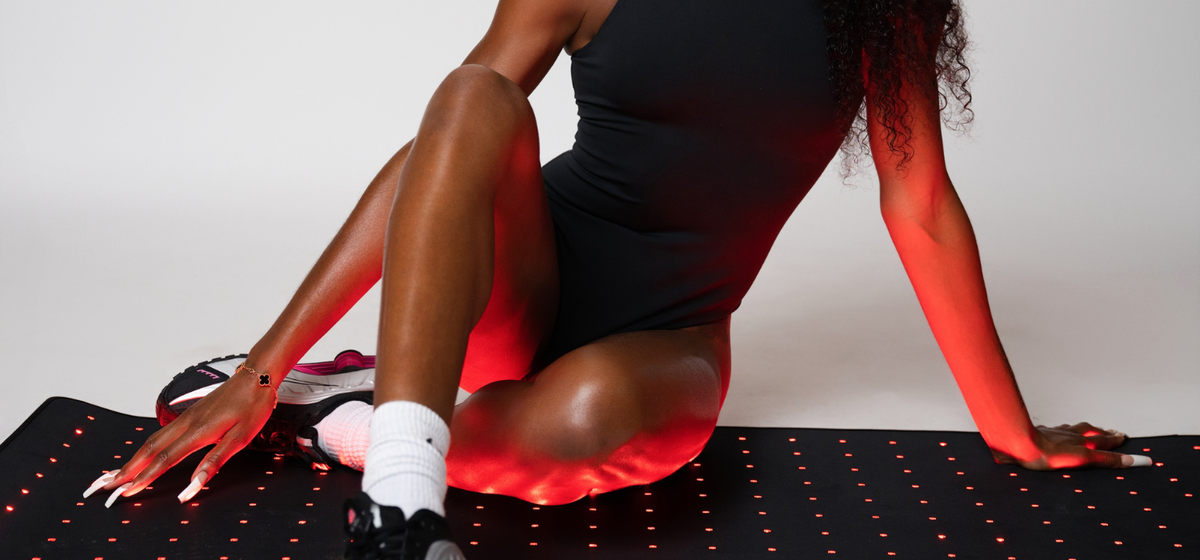
The Recovery Patch combines red and near-infrared light in a flexible, wearable format, making it easy to focus on one specific area. Here's how to fit it into your routine:
- Place it directly on the skin over the tendon area, for example around the back of your ankle for the Achilles or around your elbow.
- Follow the recommended session time of 10 minutes, 3-5 times per week. More is not better: studies show that dose matters.
- Combine it with your rehab exercises. Research consistently points to loading exercises as the foundation. Use the patch as part of that routine, for example before or after your exercises.
- Be consistent. Tendons adapt slowly, so give your routine several weeks.
- Listen to your body. Stop if the area becomes warm, swollen or more painful.
When to See a Doctor
Tendon pain is common in athletes, but some signs need professional attention. See a doctor or sports physiotherapist if:
- You felt a sudden snap or pop, or can't put weight on the area
- There is significant swelling, warmth, redness or bruising
- Pain doesn't improve after one to two weeks of reduced load
- Pain wakes you up at night or is present at rest
- You can't stand on your toes (for Achilles problems) or grip normally (for elbow problems)
- The problem keeps coming back